
August 2026 averages were $1,205,777 in Richmond Hill and $1,234,758 in Vaughan; detached homes were $3,911 apart. Here's who each city is for.
Updated September 28, 2026 with TRREB August 2026 data.
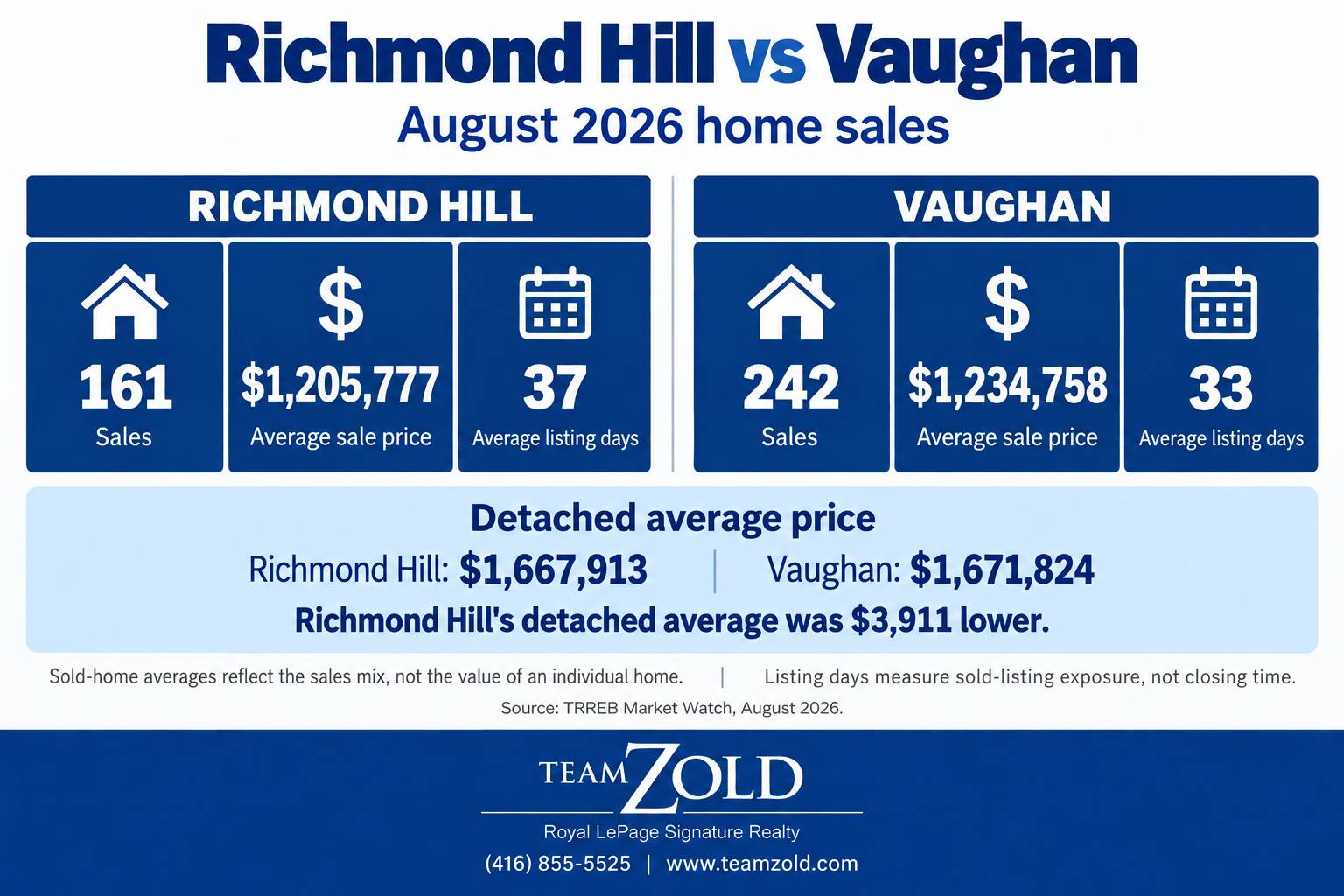
Vaughan averaged $1,234,758 and Richmond Hill $1,205,777 in August 2026, $28,981 apart, and a detached home cost almost the same in both ($1,671,824 against $1,667,913); the real difference is the commute, where Vaughan's Barrie line trains reach Union in 29 to 33 minutes against 44 to 50 from Richmond Hill's stations. Sold-home averages reflect sales mix, not like-for-like home values. Those train times cover specific morning services. Start with Vaughan real estate for rail access. Consider Richmond Hill real estate for lower condo-apartment averages and more inventory relative to sales.
How Do Richmond Hill and Vaughan Compare on Home Prices, Selling Conditions and Commutes?
The table puts August 2026 prices and selling conditions beside the named morning GO journeys and the earlier Census counts.
| Metric | Richmond Hill | Vaughan |
|---|---|---|
| Average Price (Aug 2026) | $1,205,777 | $1,234,758 |
| Median Price | $1,068,888 | $1,148,750 |
| Detached Average | $1,667,913 | $1,671,824 |
| Townhouse Average | $1,030,927 | $1,055,000 |
| Condo Apartment Average | $538,509 | $607,650 |
| Year-over-Year Change (avg) | -3.3% | +2.0% |
| SNLR Trend | 33.1% | 36.8% |
| Avg Listing Days on Market | 37 | 33 |
| Sale-to-List Ratio | 97% | 97% |
| GO Station / Time to Union | Richmond Hill GO / 50 minutes* | Maple GO / 33 minutes* |
| Population (2021 Census) | 202,022 | 323,103 |
Source: TRREB Market Watch, August 2026, with year-over-year calculations against the August 2025 report; 2021 Census, Statistics Canada; GO Transit timetables (see note). SNLR Trend uses a 12-month moving average. *Weekday train 5008 (Richmond Hill GO 7:10 a.m., Union 8:00 a.m., Table 61 effective 25 April 2026) and train 6608 (Maple GO 7:26 a.m., Union 7:59 a.m., Table 65 effective 5 and 8 September 2026). Scheduled in-train examples only; check current schedules.
Richmond Hill's sold listings averaged 37 days on market against Vaughan's 33, which measures listing exposure rather than closing time or total exposure across relistings. Both recorded a 97% sale-to-list ratio, so the faster pace in Vaughan didn't produce a higher city-wide ratio; neither figure promises a discount from an original asking price. SNLR Trend uses a 12-month moving average, rather than August sales divided by August new listings.
How Do Prices Compare, and What Do You Get for the Money?
Richmond Hill's $1,205,777 average and Vaughan's $1,234,758 were $28,981 apart in August 2026. If you're buying a detached home, though, that overall gap tells you little about the choice ahead. The property-type comparison gets you closer to the homes you're actually considering.
The year-over-year averages moved in opposite directions: -3.3% in Richmond Hill and +2.0% in Vaughan. Detached homes made up 46.0% of Richmond Hill sales and 50.4% of Vaughan sales. Different proportions of expensive and less expensive homes can move the overall average even without equivalent changes in individual home values. Within detached sales, the mix still matters.
Average Price by Property Type, August 2026
Detached homes averaged $1,667,913 in Richmond Hill on 74 sales and $1,671,824 in Vaughan on 122 sales. That's a $3,911 gap. I'd put much more weight on the particular home's condition, lot and street than on that difference.
| Property Type | Richmond Hill | Richmond Hill sales | Vaughan | Vaughan sales |
|---|---|---|---|---|
| Detached | $1,667,913 | 74 | $1,671,824 | 122 |
| Semi-Detached | $1,040,000 | 6 | $1,010,714 | 14 |
| Townhouse | $1,030,927 | 38 | $1,055,000 | 31 |
| Condo Townhouse | $716,839 | 9 | $774,669 | 9 |
| Condo Apartment | $538,509 | 33 | $607,650 | 63 |
Source: TRREB Market Watch, August 2026 (detached p. 7, semi-detached p. 9, townhouse p. 11, condo townhouse p. 13, condo apartment p. 15). Segments with fewer than 10 sales are thin and unreliable, shown for reference only.
Condo apartments offer a clearer starting point for a budget comparison: Richmond Hill averaged $538,509 on 33 sales, against Vaughan's $607,650 on 63 sales, a $69,141 gap. Townhouses averaged $1,030,927 and $1,055,000 respectively. These are sold-home averages, not prices for identical properties.
Richmond Hill's 6 semi-detached sales and both cities' 9 condo-townhouse sales are thin and unreliable for trends. They can't establish a standing price advantage. For background, the linked Richmond Hill housing market page covers March; the Vaughan August 2026 market update covers this August comparison.
How Do Richmond Hill and Vaughan Neighbourhoods Differ in Location and Price?
If an old village setting appeals to you, start with Mill Pond, west of Yonge around the pond. Its Q1 2026 all-home-type average was $1,310,941 on 17 sales. That small sample needs caution; it doesn't establish a neighbourhood price trend.
Jefferson puts you north of Gamble between Yonge and Bathurst, with the Jefferson Forest area as a point of reference. Its Q1 2026 average was $1,288,062 on 31 sales. Explore it if that northern location suits your search.
Westbrook sits west of Yonge around Elgin Mills and Bathurst. Its Q1 2026 average was $1,402,778 on 18 sales, another small sample. For a search centred on those roads, it belongs on your list alongside the broader guide to all Richmond Hill neighbourhoods.
Kleinburg offers Vaughan's village-core comparison, around Islington and Major Mackenzie. Its Q1 2026 average was $1,726,770 on 37 sales, the highest among these Vaughan examples. Like Mill Pond, its village setting is a reason to explore; their averages don't compare identical homes.
Maple makes sense if the Barrie line commute leads your decision. Around Major Mackenzie and Keele, with Maple GO, it gives that search a specific starting point. Its Q1 2026 average was $1,051,624 on 64 sales.
Patterson lies between Bathurst and Dufferin north of Rutherford. Its Q1 2026 average was $1,477,624 on 86 sales. Consider it if that location fits better than Maple's. Vaughan guides are coming; these quarterly averages cover all home types, not detached homes alone. The Richmond Hill guides use earlier periods, so keep their tables separate from these Q1 figures.
How Do Schools Compare in Richmond Hill and Vaughan?
The Fraser Institute's 2025 elementary report uses 2023/24 performance, not 2025 test results. In Richmond Hill, Silver Stream Public School received 9.3 out of 10 and ranked 74; Bayview Hill Elementary School received 8.0 and ranked 351.
In Vaughan, Michael Cranny Elementary School in Maple received 9.0 out of 10 and ranked 110. Herbert H. Carnegie Public School in Maple received 8.4 and ranked 231. Ties share a rank.
Those examples don't establish a city-wide school winner or tell you which school a particular home serves. Before you attach a school name to your buying decision, use the board's school locator for the exact address. A nearby school and an assigned school aren't automatically the same thing, and these ratings don't guarantee admission.
Which Has the Better Commute to Toronto?
Vaughan has the advantage on these weekday morning train rides to Union. Barrie line train 6608 leaves Maple GO at 7:26 a.m. and reaches Union at 7:59 a.m., a 33-minute ride; from Rutherford GO, it's 29 minutes on that train.
Richmond Hill line train 5008 leaves Richmond Hill GO at 7:10 a.m. and reaches Union at 8:00 a.m., a 50-minute ride. From Langstaff GO, it's 44 minutes. The Richmond Hill timetable is effective 25 April 2026; the Barrie timetable is effective 5 and 8 September 2026. Check current schedules.
These are in-train times, not door-to-door journeys or every service. Vaughan also has TTC Line 1's terminus at Vaughan Metropolitan Centre, opened December 17, 2017. Highway 400 and Highway 407 are Vaughan options; Highway 404 and Highway 407 serve the Richmond Hill comparison. Choose the station and route that work from the actual home.
Which One Fits the Way You Want to Live?
If you want an older village setting, I'd begin in Richmond Hill's Mill Pond, around the pond west of Yonge and beside the older core. Kleinburg is the Vaughan alternative for a village-core search, centred on Islington and Major Mackenzie. Both give you a defined setting to explore, but in different parts of the comparison; neither city-wide average describes the house you'll find there.
If your day centres on the train, start in Vaughan's Maple around Major Mackenzie and Keele, then compare access to Maple GO. For a subway-led search, focus on Vaughan Metropolitan Centre at Highway 7 and Jane.
Choose Richmond Hill if the Yonge corridor and Mill Pond setting suit you; Hillcrest Mall and Mackenzie Richmond Hill Hospital are local anchors, with Jefferson Forest farther north. Choose Vaughan if its GO or subway access carries more weight. Vaughan Mills, Canada's Wonderland and Cortellucci Vaughan Hospital add specific destinations to consider. For detached space, inspect the home itself: the averages give neither city a meaningful price lead.
What Does the Market Look Like Right Now in August 2026?
Vaughan was tighter on the smoothed supply measures: SNLR Trend was 36.8% against Richmond Hill's 33.1%, while Months of Inventory Trend was 4.9 against 5.6. Both use 12-month moving averages. Higher inventory relative to sales can leave buyers more room to negotiate, provided the specific home has comparable competition.
Sold listings averaged 33 days in Vaughan and 37 in Richmond Hill; both cities recorded 97% SP/LP. That doesn't set your offer price or promise time to decide. For sellers, compare the alternatives a buyer can see now before setting an asking price.
For earlier conditions, see the Richmond Hill housing market page, which covers March. The Vaughan August 2026 market update explains August's sales mix and results in more detail.
What Are the Most Common Questions About Richmond Hill vs. Vaughan?
Is Vaughan or Richmond Hill more expensive?
Vaughan averaged $1,234,758 against Richmond Hill's $1,205,777 in August 2026. Detached averages were nearly the same: $1,671,824 and $1,667,913 respectively. Vaughan's condo-apartment average was $69,141 higher. Sales mix affects the city-wide comparison, so start with the type of home you want and compare actual properties before deciding which city costs more for you.
Which has the better commute to downtown Toronto?
Vaughan has shorter rides on the cited morning services: Rutherford GO takes 29 minutes and Maple GO 33 on train 6608; Richmond Hill GO takes 50 and Langstaff GO 44 on train 5008. These use the September 2026 Barrie and April 2026 Richmond Hill timetables. Vaughan also has Line 1 at Vaughan Metropolitan Centre. Check current schedules and door-to-door access.
Is Vaughan a good place to raise a family?
It can fit if its housing and daily destinations suit you. Detached homes represented 50.4% of August 2026 sales. The Fraser Institute's 2025 report, using 2023/24 results, rated Michael Cranny Elementary School 9.0 out of 10, rank 110, and Herbert H. Carnegie Public School 8.4, rank 231. Cortellucci Vaughan Hospital is another local anchor. Check school assignment by address; there's no city-wide winner.
Which market is tighter right now?
Vaughan's August 2026 SNLR Trend was 36.8% versus Richmond Hill's 33.1%; Months of Inventory Trend was 4.9 versus 5.6. Both are 12-month moving averages. Listing days were 33 versus 37. Those measures point to a tighter market in Vaughan, while Richmond Hill's higher relative inventory may help buyers negotiate. Neither conclusion predicts the response to a particular listing or future prices.
What about Aurora, Newmarket or Markham?
Aurora ($1,105,004) and Newmarket ($1,048,321) averaged less than both cities in August 2026, while Markham ($1,208,692) sat between them. For those northern alternatives, read Aurora vs Richmond Hill and Richmond Hill vs Newmarket. Keep the comparison tied to the home type and commute you need; an all-home-type average alone doesn't tell you what a comparable property will cost.
Are property taxes higher in Richmond Hill or Vaughan?
Richmond Hill's 2026 total residential rate is 0.760104%, compared with Vaughan's 0.749217%. The regional and education portions are identical; the local share differs. Those rates apply to MPAC assessed value based on January 1, 2016, not the purchase price. Richmond Hill has the higher rate, but compare the actual assessments before drawing a conclusion about the bills for particular homes.
So, Should You Buy in Richmond Hill or Vaughan?
Start with Vaughan real estate if the Barrie line or Vaughan Metropolitan Centre subway connection will shape your day. Start with Richmond Hill real estate if a lower condo-apartment average and more inventory relative to sales are your priorities. For detached homes, I'd let the street and the property settle it.
If you're weighing Mill Pond, Jefferson or Maple, talk to Team Zold. I'd be happy to compare two specific homes with you, work through their asking prices and recent comparable sales, and look at how each location fits your day. That's where this city comparison becomes a useful buying decision.
Shawn Zigelstein, Broker
Team Zold, Royal LePage Signature Realty
📞 (416) 855-5525
🌐 www.teamzold.com