
By Shawn Zigelstein, Broker, Team Zold
Aurora Highlands is the deepest, most reliable dataset in Aurora, and in Q1 2026 it delivered the tightest pricing in town: 33 sales at a 99% sale-to-list ratio, with the detached segment also closing at 99% of asking. The blended average came in at $1,233,091 with a $1,178,000 median, while detached itself averaged $1,374,000 across 25 sales. Sellers here are giving up almost nothing on price. What buyers do get is selection: 89 new listings hit the market this quarter and only about a third of the detached ones sold.
For a broader look at how Aurora Highlands fits within the rest of Aurora, take a look at our Aurora Neighbourhoods Guide.
Where is Aurora Highlands in Aurora?
Aurora Highlands is west of Aurora: Bathurst Street on the west, Wellington Street West to Murray Drive across the north, Yonge Street on the east, and the GO rail line on the south. The neighbourhood sits on a high plateau, noticeably higher ground than most of the town, and its southern border runs into conservation land on the Oak Ridges Moraine. It's one of Aurora's largest neighbourhoods by area, family-oriented, with the broadest housing mix in town.
What the Data Actually Shows in Aurora Highlands
Here is what TRREB recorded for Aurora Highlands in Q1 2026:
Aurora Highlands Market Snapshot — Q1 2026
| Metric | Q1 2026 |
|---|---|
| Sales | 33 |
| Dollar Volume | $40,692,000 |
| Average Price | $1,233,091 |
| Median Price | $1,178,000 |
| New Listings | 89 |
| Active Listings | 39 |
| Sale-to-List Ratio | 99% |
| Avg Days on Market | 32 |
Source: TRREB Aurora Community Market Report, Q1 2026.
Aurora Highlands Property Type Breakdown — Q1 2026
| Property Type | Sales | Avg Price | Median Price | New Listings | SNLR | DOM | SP/LP |
|---|---|---|---|---|---|---|---|
| Detached | 25 | $1,374,000 | $1,350,000 | 70 | 36% | 35 | 99% |
| Condo Apt | 4 | $834,000 | $893,000 | 7 | 57% | 24 | 99% |
| Condo Townhouse | 2 | n/a | n/a | 7 | n/a | n/a | n/a |
| Att/Row/Townhouse | 1 | n/a | n/a | 1 | n/a | n/a | n/a |
| Semi-Detached | 0 | n/a | n/a | 3 | n/a | n/a | n/a |
Source: TRREB Aurora Community Market Report, Q1 2026. SNLR = Sales-to-New-Listings Ratio. TRREB does not report detailed stats for segments with two or fewer sales.
What this table is actually saying:
Volume makes this the truest read in Aurora. Thirty-three sales, 25 of them detached, is the most transaction depth any Aurora neighbourhood produced in Q1. When Aurora Highlands numbers move, it means something; this isn't a five-sale market where one estate skews everything.
The 99% detached SP/LP means the discount window stayed shut. On a $1,374,000 detached average, one point off asking is roughly $14,000 of negotiating room, and that's all this neighbourhood conceded in Q1. Compare that with 93% detached in Bayview Northeast or Aurora Grove the same quarter. Sellers here price accurately and buyers pay it.
But absorption tells the buyer's side of the story. Seventy new detached listings, 25 sales: a 36% absorption rate. So while sold prices are firm, most listings didn't sell, and the ones that aged are where flexibility eventually shows up. Selection without discounts is still selection.
The detached average stepped down from Q4, and that's mix, not collapse. Q4 2025 detached averaged $1,706,000 on 19 sales, heavy with the newer luxury builds; Q1 2026's 25 sales came in at $1,374,000, closer to the Regency Acres end of the stock. Same neighbourhood, different blend of eras selling. Know which sub-market your target home belongs to before you read any average.
The condo apartments were the quiet surprise. Four sales at 99% of asking in 24 days, absorbing 57% of new listings, with a median of $893,000. Small numbers, but the pattern says entry-level product here gets taken quickly when it appears.
What Kind of Homes Does Aurora Highlands Have?
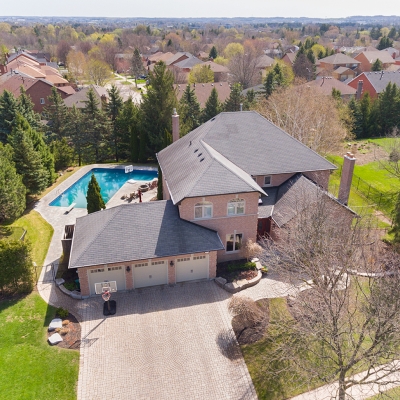
The housing splits into two distinct eras. The Regency Acres pocket, around Regency Acres Public School, is 1960s and 70s two-storey homes, semis, split-levels, and bungalows on established streets. Then there's the newer luxury end, with Allegro as the most recent development: executive-style four- and five-bedroom homes on 52-to-61-foot lots with mature trees. A 1970s renovation project and a $2 million custom can share this postal code, which is exactly why the quarterly averages swing with the mix.
What Schools are in Aurora Highlands?
The secondary pipeline is the draw: Aurora High School (Fraser 8.4 out of 10, ranked 46th of 747 in Ontario) and Dr. G.W. Williams Secondary (Fraser 8.3, ranked 52nd, with the IB Diploma Programme). On the elementary side, Wellington P.S. (Fraser 7.3), Highview P.S., and Holy Spirit C.E.S. serve parts of the neighbourhood, with Regency Acres P.S. (Fraser 6.2) covering its own pocket, and Lester B. Pearson P.S. handling French Immersion region-wide. The catchment caveat matters here more than most places: two streets in this neighbourhood can put you in two different elementary schools. Run the exact address through the YRDSB School Locator before you write an offer.
How is the Commute from Aurora Highlands?
The GO rail line forms the neighbourhood's southern boundary, and the Aurora GO Station is a short drive for most streets here. Yonge Street on the eastern edge carries Viva Blue.
Aurora's transit story is rail, not subway. The Aurora GO Station sits at Wellington Street East and Industrial Parkway on the Barrie Line, with peak trips to Union Station running about 54 minutes and service that is heavily peak-direction biased. The upgrade worth watching: Metrolinx began construction in August 2023 on work that will enable future all-day, two-way 15-minute service between Aurora and Union. The Yonge North Subway Extension is not coming to Aurora; it terminates in Richmond Hill, so the Barrie Line improvement is the transit development that actually matters here.
Viva Blue runs along Yonge Street with 5-to-10-minute peak headways, connecting south through Richmond Hill and Vaughan to Finch subway station. For drivers, Highway 404 runs along Aurora's eastern edge and Highway 400 sits to the west via Wellington or Bloomington, with the 404 run to the 401/DVP merge taking roughly 14 to 24 minutes off-peak and considerably longer in rush hour.
What to Consider Before Buying in Aurora Highlands
Know your era before you know your budget. The Regency Acres stock needs the renovation conversation, kitchens, baths, and mechanicals from the 60s and 70s, while Allegro-end homes carry new-build premiums. The neighbourhood average sits uselessly between the two.
Don't wait for a discount that isn't coming. Two full years of data now show this neighbourhood holding 98-to-99% of asking through soft markets and strong ones. The opportunity here is selection and aged listings, not price capitulation.
The moraine edge is the durable premium. The southern streets against Oak Ridges Moraine conservation land have protected sight lines that aren't changing. Like golf-course backing elsewhere, that's a materially different asset at resale.
Insider Tip
Two patterns worth knowing. First, the detached mix swing between Q4 ($1,706,000 average) and Q1 ($1,374,000) is the widest quarter-to-quarter move in Aurora, and it's entirely about which era of stock traded; if a listing agent quotes you either number without naming the sub-market, be skeptical. Second, with 39 active listings against 89 new ones this quarter, a meaningful share of inventory is aging; the sellers behind those listings are the negotiable end of a non-negotiable neighbourhood. Confirm the current picture with the Team Zold team before you offer.
Similar Neighbourhoods to Consider
If Aurora Highlands is on your shortlist, three other Aurora pockets are worth a look:
Aurora Heights for the same west-side established feel at a lower entry point. Its post-war detached stock traded at an average of $1,151,000 in Q1 2026, and its renovation-project economics are a gentler version of Regency Acres.
Rural Aurora for buyers who want the newer-construction end of the Highlands equation without the mixed-era guesswork. Detached there averaged $1,614,000 in Q1 at 98% of asking, on post-2010 stock with bigger lots.
Aurora Village for heritage character and GO-station walkability. Its detached market averaged $1,494,000 in Q1, with condo entry points in the $400,000s and $600,000s that Highlands mostly lacks.
Aurora Highlands — Where the Market Goes From Here
My read: Aurora Highlands is the bellwether. It carries the most volume in town, it holds its pricing in every market, and its two-era housing stock means it serves both the move-up family and the luxury buyer. The Q1 setup, firm prices with soft absorption, is the same picture most of Aurora is showing, and when the spring demand builds, this is where it shows up first, because this is where the listings are. If the 36% absorption rate starts climbing quarter over quarter, that's your signal the whole town is turning. Want to be positioned before that? Let's talk streets and sub-markets.