Better late than never: Canada’s delayed spring housing market could set the stage for a more active second half of the year
By: Royal LePage
TORONTO, July 14, 2026
In Q2 2026, the national aggregate home price rose a modest 0.2% over Q1 2026
According to the Royal LePage® House Price Survey and Market Forecast, the aggregate1 price of a home in Canada decreased 1.4% year over year to $814,900 in the second quarter of 2026. On a quarter-over-quarter basis, however, the national aggregate home price remained flat, increasing a modest 0.2%.
“After a sluggish first quarter, the spring housing market finally got rolling in May. Several regions are now seeing that uptick in momentum carry into summer, as buyers who held back earlier in the year re-enter the market,” said Phil Soper, president and CEO, Royal LePage. “In many cases, what has kept consumers on the sidelines is not a lack of interest, but a lack of urgency. In markets where inventory levels remain elevated, homebuyers have the luxury of time, browsing at their own pace until the right property comes along. That measured approach is reinforced by a persistent backdrop of economic uncertainty, which continues to shape how and when many Canadians decide to move.”
In May, Canada’s Consumer Price Index (CPI) rose 3.2% year over year, up from 2.8% in April,2 the highest reading since January 2024. The acceleration has been largely driven by rising energy prices, which continue to reflect the impact of hostilities in the Middle East. Bank of Canada Governor Tiff Macklem indicated in June, however, that inflationary pressures have not spread broadly in a way that would signal a wider rise in general inflation. The Bank of Canada’s key lending rate remains at 2.25%, untouched since October 2025.
Read full article HERE
REGIONAL SUMMARIES
Greater Toronto Area
The aggregate price of a home in the Greater Toronto Area (GTA) decreased 4.6 per cent year over year to $1,101,700 in the second quarter of 2026. On a quarterly basis, however, the aggregate price of a home in the GTA increased a modest 0.9 per cent.
Broken out by housing type, the median price of a single-family detached home decreased 3.6 per cent year over year to $1,396,500 in the second quarter of 2026, while the median price of a condominium decreased 5.7 per cent to $660,000 during the same period.
“After a slow start to the year, we are finally starting to see a turnaround in the GTA market. Conditions are tightening; we’ve seen consistent improvement in activity levels from one month to the next and a decline in new listings, causing prices to slowly inch upward. We’ve even begun to see improvement in the condo market, with sales up slightly over last year,” said Shawn Zigelstein, broker and leader of Team Zold, Royal LePage Signature Realty. “While the region remains in a buyers’ market, momentum began shifting toward balanced conditions in the second quarter, in line with our expectations for a gradual recovery. That said, economic uncertainty and geopolitical tensions continue to weigh on consumer confidence, keeping many would-be buyers on the sidelines. Meanwhile, sellers are listing only when they absolutely have to, which is contributing to shrinking supply levels.”
Zigelstein noted that the late arrival of warm weather brought with it a spark of renewed energy from the first-time buyer segment.
“First-time homebuyers are beginning to come alive again. Improving affordability is drawing some of them back into the market, though many remain cautious. What this segment of the market needs most is more well-priced inventory, although a majority still rely on family support for their down payment,” he added.
In the city of Toronto, the aggregate price of a home decreased 2.7 per cent year over year to $1,120,800 in the second quarter of 2026. Meanwhile, the median price of a single-family detached home decreased 9.8 per cent year over year to $1,515,000, while the median price of a condominium decreased 2.5 per cent to $658,600.
“Looking ahead, we expect activity to continue increasing, with the exception of the condo market, which is likely to remain soft given elevated inventory and selling pressure from investors. If supply continues to decline and pent-up demand remains significant, particularly among move-up buyers who delayed decisions over the past two years, we could see more competitive conditions come the fall.”
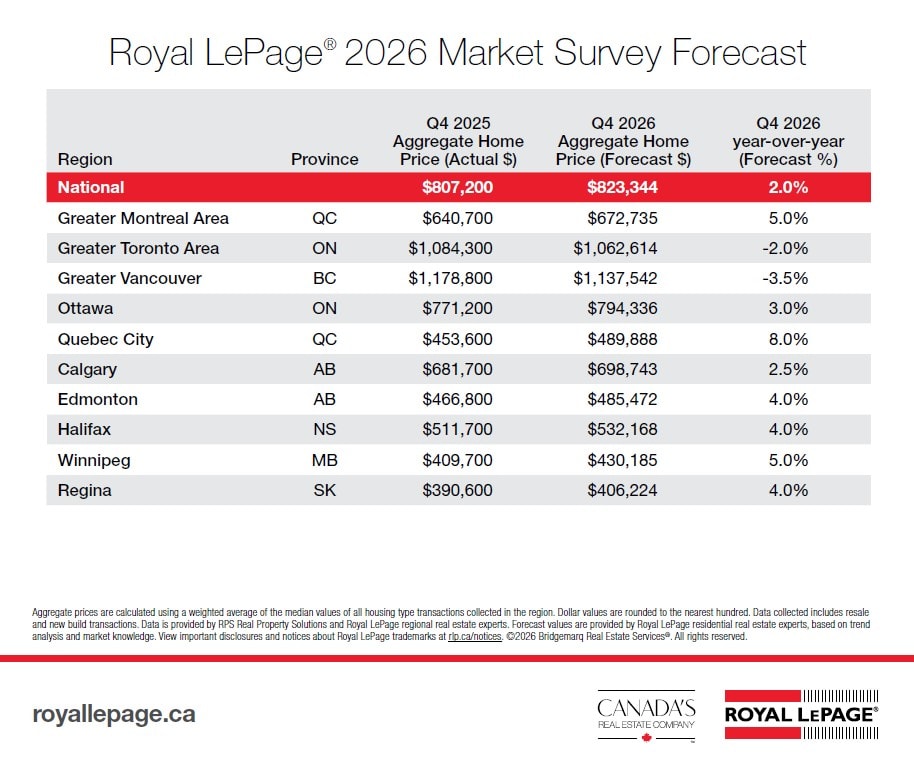
Royal LePage is forecasting that the aggregate price of a home in the Greater Toronto Area will decrease 2.0 per cent in the fourth quarter of 2026, compared to the same quarter last year. The previous forecast has been revised upward to reflect current market conditions.
Royal LePage House Price Survey Chart: rlp.ca/house-prices-Q2-2026
Royal LePage Forecast Chart: rlp.ca/market-forecast-Q2-2026
Second quarter highlights:
- In the second quarter of 2026, the national aggregate home price decreased 1.4% year over year; increased just 0.2% compared to the first quarter.
- The Greater Toronto and Vancouver markets recorded year over year declines of 4.6% and 4.5%, respectively, in Q2. On a quarterly basis, however, prices showed signs of stabilization.
- Quebec City’s record performance begins to cool; region posts quarter-over-quarter price decline for the first time in more than three years.
- Final remnants of ultra-low, pandemic-era mortgages will come up for renewal by the end of 2027.