Prices decreased year-over-year in Greater regions of Toronto and Vancouver, while Quebec, the Prairies and Atlantic Canada recorded price appreciation
By: Royal LePage
TORONTO, April 16, 2026
In Q1 2026, the national aggregate home price ticked up a modest 0.7% over Q4 2025
Canada’s spring housing market is beginning to show signs of life after a long winter that kept many buyers and sellers on the sidelines. While headlines around economic uncertainty and global conflict continue to weigh on consumer confidence, a recent uptick in activity suggests a slow but welcome start to the spring market.
According to the Royal LePage® House Price Survey and Market Forecast, the aggregate1 price of a home in Canada decreased 2.0% year over year to $812,900 in the first quarter of 2026. On a quarter-over-quarter basis, however, the national aggregate home price remained relatively flat, increasing just 0.7%.
In the first quarter, the aggregate price of a home decreased 4.7% in the Greater Toronto Area and 4.5% in Greater Vancouver.
Read full article HERE
REGIONAL SUMMARIES
Greater Toronto Area
The aggregate price of a home in the Greater Toronto Area (GTA) decreased 4.7 per cent year over year to $1,091,900 in the first quarter of 2026. On a quarterly basis, however, the aggregate price of a home in the GTA increased a modest 0.7 per cent.
Broken out by housing type, the median price of a single-family detached home decreased 4.5 per cent year over year to $1,382,300 in the first quarter of 2026, while the median price of a condominium decreased 6.5 per cent to $658,000 during the same period.
“The spring market is quietly building momentum, with home sales in Toronto rising modestly year over year at the end of the first quarter. Price growth, however, remains flat from one month to the next as elevated supply levels keep conditions balanced,” said Shawn Zigelstein, broker and leader of Team Zold, Royal LePage Signature Realty. “The condo segment has seen a slight uptick in activity, driven largely by interest from first-time buyers and downsizers. At the same time, inventory throughout the city has been trending downward, as many sellers are choosing to relist at a later date rather than accept lower offers. This signals a level of confidence among sellers, but it’s also contributing to a degree of gridlock, with buyers and sellers waiting for more favourable conditions to move forward.”
Zigelstein noted that uncertainty around interest rates has prompted a small segment of first-time buyers to enter the market in recent weeks. With fixed mortgage rates increasing amid pressure on bond yields, many are choosing to act now while they have a favourable mortgage rate locked in place, before their loan pre-approvals expire.
In the city of Toronto, the aggregate price of a home decreased 4.8 per cent year over year to $1,070,600 in the first quarter of 2026. Meanwhile, the median price of a single-family detached home decreased 9.7 per cent year over year to $1,528,900, while the median price of a condominium decreased 3.8 per cent to $660,600.
“Last year’s spring market fell short of expectations. With strong inventory levels and stable pricing helping to attract buyers, we’re optimistic that the foundation is in place for more robust activity in 2026,” said Zigelstein. “Buyers are out exploring and doing their homework, but many aren’t moving aggressively with offers just yet. One potential catalyst for increased activity is the possibility of interest rate hikes in response to rising inflation, which could prompt some buyers to act sooner than later. At the same time, that urgency is being tempered by broader economic concerns, including job security, which remain top of mind for many consumers.”
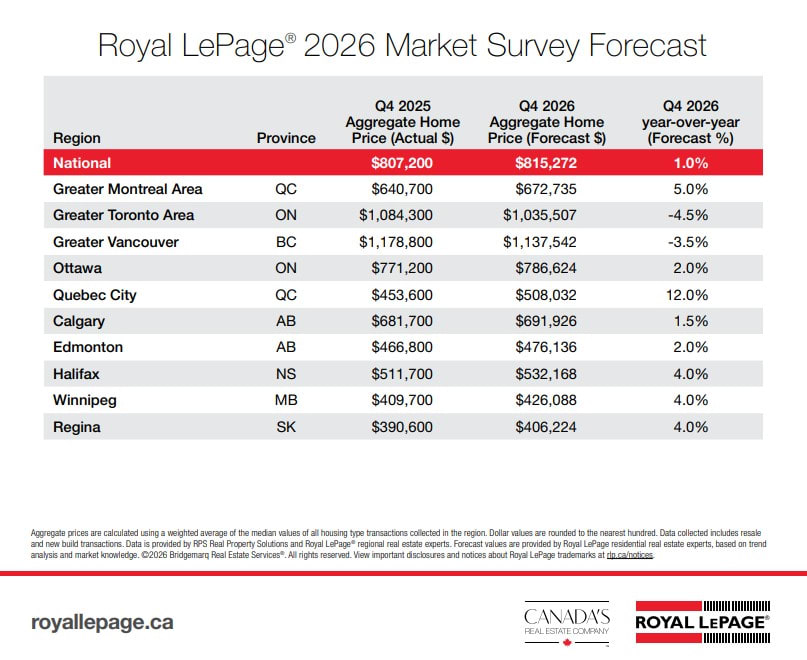
Royal LePage is forecasting that the aggregate price of a home in the Greater Toronto Area will decrease 4.5 per cent in the fourth quarter of 2026, compared to the same quarter last year.
Royal LePage House Price Survey Chart: rlp.ca/house-prices-Q1-2026
Royal LePage Forecast Chart: rlp.ca/market-forecast-Q1-2026
First quarter highlights:
- The Greater Montreal Area’s aggregate home price increased 4.5% year over year, while the greater Toronto and Vancouver markets recorded declines of 5.7% and 4.1%, respectively, in the fourth quarter.
- Quebec City recorded the highest year-over-year aggregate price increase (13.2%) among Canada’s major regions for the seventh consecutive quarter.
- Royal LePage expects spring market activity to rise, but not surge, as buyers re-engage amid reduced borrowing costs and improved housing affordability.